

What gets delivered
Three shapes, and a phase that comes before them where it's needed.
-
Deciding who you are in public. Then deciding how to photograph it.
Together we work out who you are at your best - your people, what you believe, how you speak, what you won't do, what someone should feel walking in and what they'd say about you to a friend the next day. We work through your point of view together, and it comes back as a written direction: short, specific, and made to make the work that comes after easier and better
What comes out is what every later decision answers to. The pictures first. Then the site, the menus, the room you haven't built yet, the next person you hire.
-
A curated set of eight to twelve images.
Curating is most of the work, and it's what decides whether the pictures are still useful in three years.
Most people who commission this don't do it often. A restaurant, a workshop, a hotel photographs itself properly once every few years and then lives on that set. So the job isn't to produce as much as possible in a day. It's to come back with a small number of pictures that are true about the place and hold up after the menu, the season and half the staff have changed.
They're chosen to work apart and together. In practice they get scattered - one on the homepage, three in a deck, one printed large by the door, one sent to a magazine that asked for something today. Each has to carry on its own. They're picked as a group as well, so the site, the press image and the wall at the entrance read as one place rather than three.
A sequence is built around one question the pictures try to answer. It's written down before the shoot and it goes in the brief-back, so you know what I'm looking for and can tell me if it's the wrong question.
-
A broad set, usually forty to a hundred images.
A relaunch. A new site. A hotel with rooms and seasons to cover. A year of material to draw on. The problem here isn't choosing - it's having something for every page, every format and every month, so nobody ends up filling a gap with a phone picture or something licensed from a stock site. That mixture is what makes an otherwise good site look uneven, and it usually happens six months after the photography, not during it.
Priced and licensed differently, since it's made for volume and you'll be using it for years.
-
A single portrait. A piece made over several visits. A book. A year photographed in four parts. When the work wants its own shape, we write down what it is before anyone talks about money - what it covers, how many images, what it's for.
If you're not sure which one you need, tell me what the pictures are for and I'll tell you what I think. Sometimes the answer is Direction first.
What I need from you
The useful brief answers one question: what should someone understand or feel about this organisation after seeing the pictures.
After that, the most useful thing you can give me is where the pictures have to go. A header wide enough to take a headline. A vertical frame that survives a phone screen. The room empty, for the times you can't use anyone's face. Something with the resolution and the space to run across a magazine spread. These are easy things to shoot when I know about them on the day, and nearly impossible to invent afterwards.
The Process
-
![]()
01 Enquiry
What the pictures are for, roughly when, and where.
-
![]()
02 Response
I come back with questions. Usually: who or what is the subject and why them specifically, which spaces and hours I'd need access to, where the images will appear, and how long you need them for.
-
![]()
03 Written proposal
Every project is different. I stay flexible and responsive to make sure the process fits your flow, not the other way around.
-
![]()
04 Brief-back before the shoot
A short note setting out what I understood and what the pictures need to do. It's where a misunderstanding gets caught before anyone has spent money.
-
![]()
05 Contract signed
Subject releases where people are identifiable and the use is commercial.
-
![]()
06 Delivery, with a note
What the sequence does, what to use where. Not just a bare link.
If the set doesn't hold together, that's a reshoot or a conversation, and the terms for that are written into the agreement in advance rather than negotiated if someone is unhappy.


Usage
Stated three ways, every time: what, where, how long.
Standard grant: your own channels, in perpetuity, with credit. Website, social, newsletters, decks, PR, your own printed material.
Priced separately: paid advertising, out-of-home, packaging, third-party use, resale or sublicensing, and territory broader than agreed. None of these are refusals. They're different numbers, and they're cheaper agreed at the start than added later.
Territory is real: Sweden only and worldwide are different prices. Say which you need and I'll price it once.
I keep copyright and the right to show the work in my own portfolio, on my own channels and in submissions. If there's an embargo, a confidentiality requirement or a subject who can't appear publicly, tell me at enquiry and it goes in the agreement.
What to expect
-
F-skatt, VAT-registered. Payment terms: 30 days.
-
Professional indemnity and public liability insurance
-
14 working days for the sequence. Faster is possible and costed.
-
High-resolution TIFF or JPEG, colour-managed, plus web-sized versions. Raw files are never part of a delivery.
-
Colour, tone and cleanup are included. Compositing, object removal and cosmetic retouching beyond that are quoted separately.
-
Analogue photography is part of how I work. Where it belongs in a commission it's included, not surcharged. Film goes to Carmencita Film Lab and is scanned there before the negatives travel back. I photograph the same subjects digitally on the day, so nothing you need is waiting on a lab queue.
-
If your deadline is tight, say so at enquiry and the commission is shot digital-only. Film is part of the method, not an obligation to impose on a launch date.
-
I travel, and travel is shown as a separate line rather than buried in the fee.
-
Digital is shot on two bodies, with dual-card recording, backed up to two locations before the day ends.
What this is for
The work is strongest where identity is already real and needs to be seen: hospitality, food and drink, design, architecture, craft, cultural institutions, heritage, travel, and founder-led businesses where the founder is the point.
It's a poor fit for continuous short-form content, and for reproducing a reference collection assembled from elsewhere.
If the visual direction isn't settled yet, say so at the start. That's what Direction is for, and it's a better place to begin than a shoot.
Past Projects
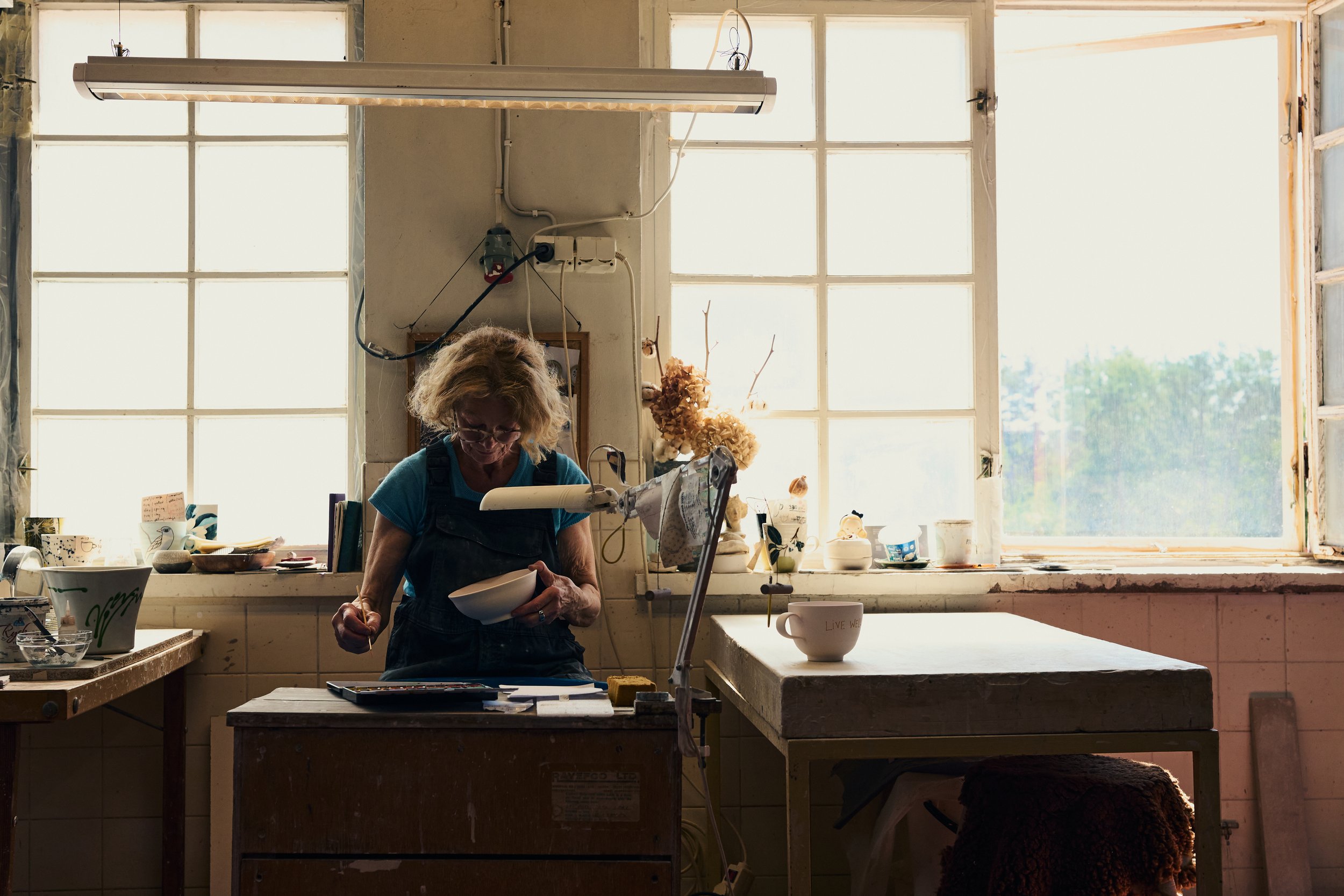
There’s a Potter in the Slaughterhouse
Judy Bradleys Ceramics Studio in the Åland Islands
Let’s Work TogetherIf you're interested in working with me, complete the form with a few details about your project. I'll review your message and get back to you within 24 hours.